
Venezuela Earthquake 2026: A Seismotectonic Perspective on the Twin Ruptures
The Venezuela earthquake 2026 sequence struck northwestern and central Venezuela on 24 June, centred in Veroes, a municipality of Yaracuy state. The first event, measuring Mw 7.2, occurred at 18:04 local time and was later classified as a foreshock; it was followed only 39 seconds later by a Mw 7.5 mainshock. The shaking caused widespread destruction across the country, most severely in La Guaira and the capital, Caracas, and the mainshock was the strongest earthquake to affect Venezuela since the 1900 San Narciso earthquake.
Tectonic Setting
Understanding the Venezuela earthquake 2026 requires situating it within the country’s broader tectonic framework. Northern Venezuela sits within a broad, transpressional boundary zone between the Caribbean Plate and the South American Plate, rather than along a single, well-defined fault. This is a key distinction from simpler subduction-zone earthquakes: deformation here is distributed across a network of active strike-slip structures rather than concentrated on one throughgoing rupture surface.
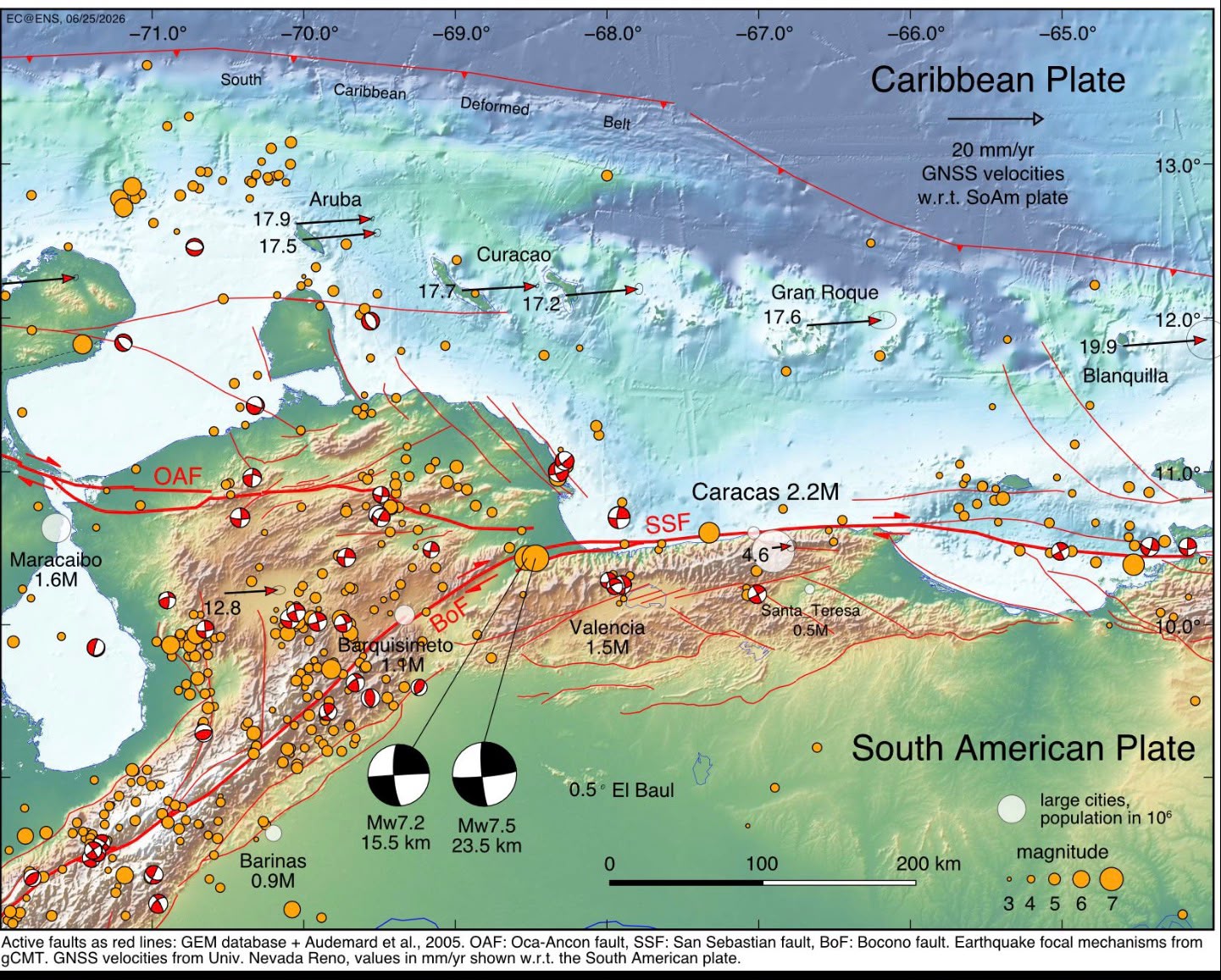
The seismotectonic map accompanying this article illustrates this complexity. GNSS velocity vectors show the Caribbean Plate moving eastward relative to South America at rates of roughly 12 to 20 mm/yr, values that are accommodated across several major faults, most notably the Oca-Ancón Fault (OAF), the San Sebastián Fault (SSF), and the Boconó Fault (BoF). These structures together transect the Mérida Andes and the Caribbean coastal ranges, forming the primary seismogenic backbone of northern Venezuela.
The focal mechanisms plotted near Barquisimeto correspond to the two earthquakes of the Venezuela earthquake 2026 sequence: a shallower Mw 7.2 event at approximately 15.5 km depth, followed by the deeper Mw 7.5 mainshock at approximately 23.5 km. Their strike-slip “beach-ball” signatures are consistent with lateral motion along the Boconó Fault system, one of the principal structures accommodating oblique convergence between the two plates. Historical seismicity, plotted across the map as orange circles scaled by magnitude, shows that this fault network has repeatedly generated earthquakes in the magnitude 5–7 range over recent decades, underscoring that the June 2026 rupture, while unusually large, occurred along a corridor with a well-documented history of moderate-to-large seismicity.
Humanitarian Impact
More than 1,700 people are confirmed to have died since the Venezuela earthquake 2026 struck, with search-and-rescue operations continuing for days afterward in Caracas and La Guaira, where entire residential blocks collapsed. The event triggered over 138 recorded aftershocks in the following week and prompted an international humanitarian response, including the deployment of urban search-and-rescue teams from multiple countries and emergency funding commitments from international donors.
Why This Matters for Coastal Geohazard Research
The Venezuela earthquake 2026 illustrates why continuously updated seismotectonic mapping matters for hazard assessment in transpressional plate-boundary settings. Combining active fault databases, historical seismicity records, GNSS geodesy, and focal mechanism solutions allows researchers to visualize how strain accumulates and releases across a distributed fault network rather than a single structure. The Boconó Fault system, much like other major strike-slip structures worldwide, demonstrates how relatively narrow deformation belts can concentrate seismic hazard directly beneath densely populated coastal and Andean cities — a pattern of direct relevance to the UNESCO Chair’s ongoing work on coastal geohazard analysis, active faulting, and palaeoseismicity.
📹 A short visual explainer on the Venezuela earthquake sequence is available here: Instagram Reel