
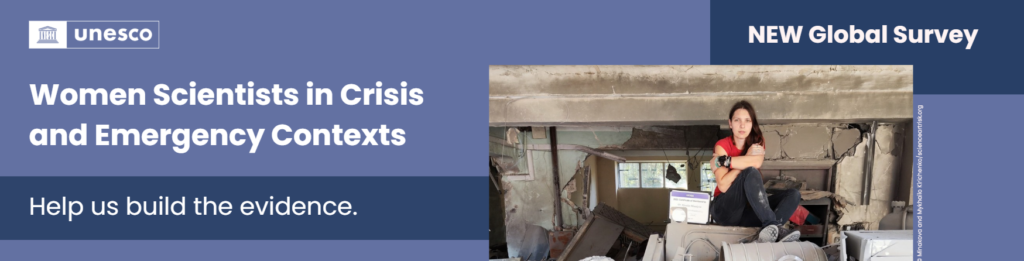
Women Scientists in Crisis and Emergency Contexts is the focus of a new global survey launched by UNESCO in collaboration with Data-Pop Alliance. Scientists and scientific organizations worldwide are invited to contribute to a stronger evidence base on the roles, experiences, needs and challenges of women scientists working in or affected by crises and emergencies.
Women scientists make vital contributions to knowledge, innovation and community resilience. Their expertise helps communities anticipate risks, respond to emergencies and recover from disruption. Yet crisis settings can deepen existing inequalities, disrupting careers, causing displacement, limiting access to research infrastructure and excluding women from decision-making and leadership opportunities.
Who can participate?
The Global Survey on Women Scientists in Crisis and Emergency Contexts includes two questionnaires designed for different participants:
- Individual scientists: women and men who have experienced a crisis or emergency, or who currently work in such contexts.
- Scientific organizations and institutions: organizations that support women scientists, particularly in crisis and emergency settings.
Survey responses will complement desk research and key-informant interviews. Together, these sources will help identify leadership roles, professional experiences, institutional practices, barriers and practical opportunities to strengthen support for women scientists.
Access the surveys
Take the Individual Survey Take the Organizational Survey
Both questionnaires are available in all six official United Nations languages: Arabic, Chinese, English, French, Russian and Spanish. The survey takes approximately 20 minutes to complete, and all language versions are available through the same links.
Survey deadline: 22 November 2026
What the study seeks to understand
The research examines how women scientists contribute before, during and after crises, including through research, innovation, technical advice, public communication and institutional leadership. It also considers the conditions that enable or restrict their work, such as access to laboratories and data, professional networks, funding, mobility, safety and continuity of employment.
The organizational questionnaire gathers information about current initiatives, institutional practices and support mechanisms. The individual questionnaire focuses on personal and professional experiences, perspectives and priorities. Responses from women and men are valuable because they can reveal how institutions and scientific communities respond to unequal impacts in different settings.
Why your participation matters
Broad participation from scientists and organizations will provide a clearer picture of the realities women scientists face during crises. The findings will inform evidence-based recommendations to strengthen participation, protection, recognition, research continuity and access to leadership and decision-making.
By sharing first-hand experience and institutional knowledge, participants can help identify practical measures that work across disciplines, regions and types of emergency. A diverse response base will also make it easier to distinguish recurring structural barriers from challenges that are specific to a particular crisis or scientific field.
How institutions and networks can support the survey
Universities, research centres, partner institutions, professional associations and members of academic and scientific communities are encouraged to circulate this invitation. The survey can be shared through newsletters, mailing lists, websites, social media, meetings, seminars and relevant events taking place before the deadline.
Organizations can also forward the individual invitation directly to scientists whose expertise or experience may be relevant. Where appropriate, they may use the official English and French campaign materials below to ensure that the purpose, audience and closing date of the survey are communicated clearly.
Download the invitation letters
- Invitation for individual scientists (Word document in English and French)
- Invitation for scientific organizations and institutions (Word document in English and French)
Official campaign materials
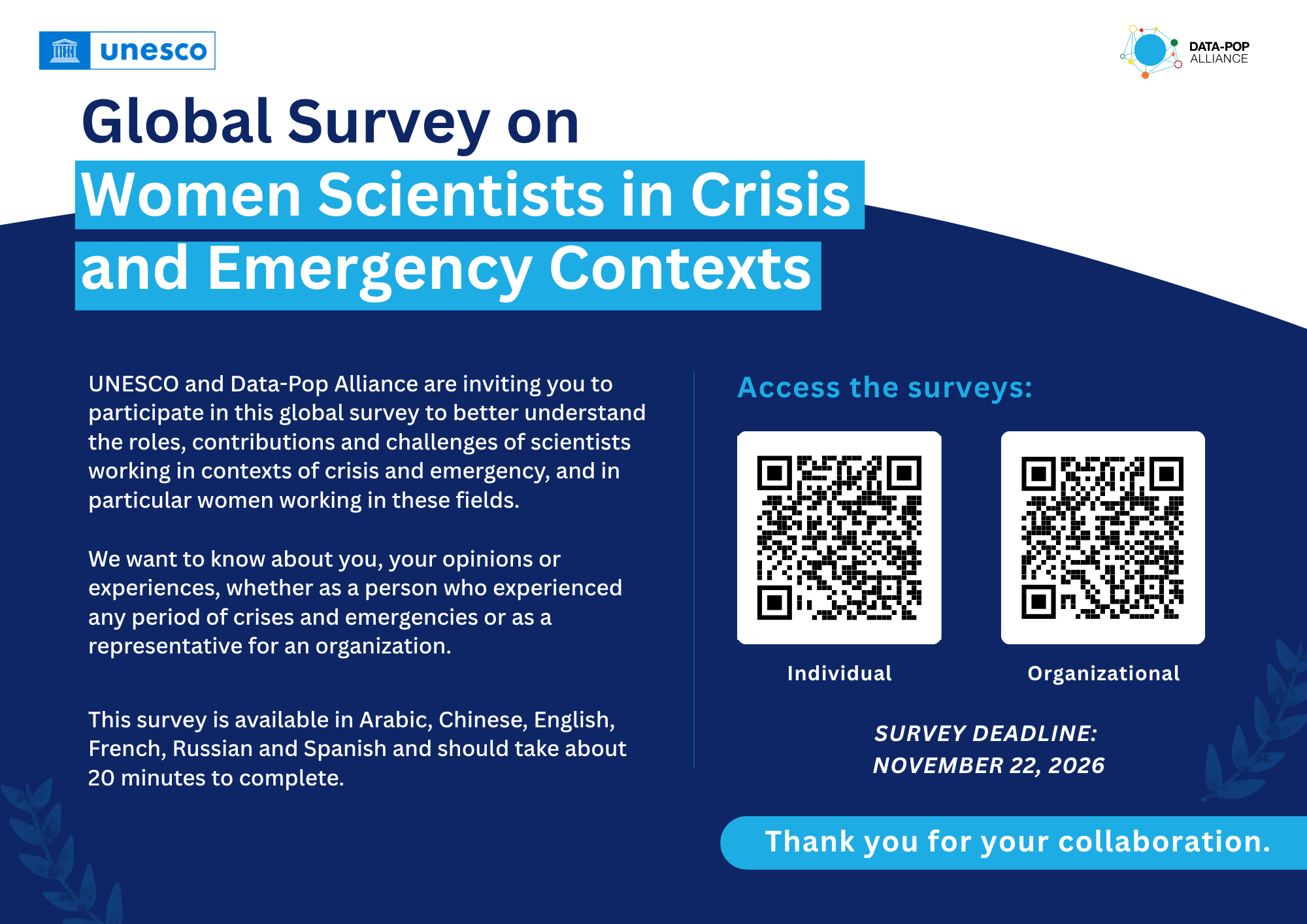
View and download the French campaign flyer
Further information
Read UNESCO’s official article, Participate in UNESCO survey: Women scientists in crisis and emergency contexts, for more information about the initiative.
For additional enquiries, contact UNESCO at rssr@unesco.org.
Each completed response will help UNESCO develop practical recommendations for more inclusive, resilient and supportive scientific systems worldwide.