
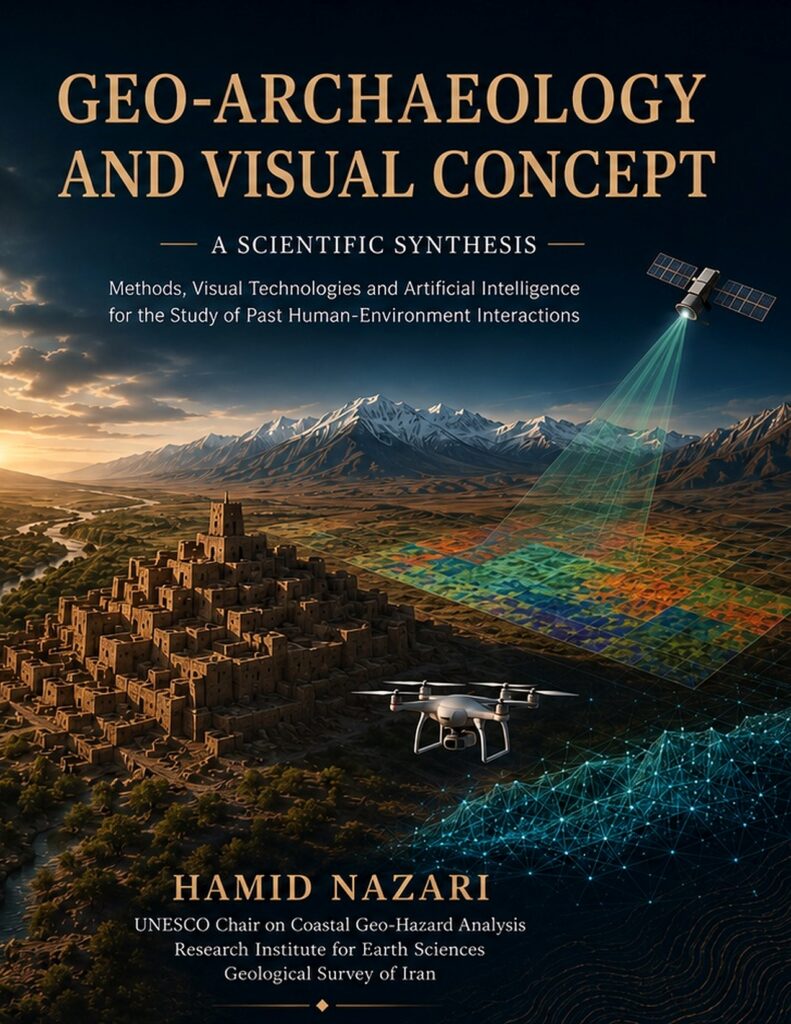
Geoarchaeology and Visual Concept: A Scientific Synthesis
Hamid Nazari, UNESCO Chair on Coastal Geo-Hazard Analysis at the Research Institute for Earth Sciences, Geological Survey of Iran, has published a new scientific book titled “Geoarchaeology and Visual Concept: A Scientific Synthesis.”
This comprehensive work explores the intersection of geoarchaeology, visual technologies, and artificial intelligence in understanding past human-environment interactions — a field of growing importance in both earth sciences and cultural heritage research.
About the Book
Geoarchaeology and Visual Concept: A Scientific Synthesis addresses a growing need in the earth sciences and archaeological communities: the integration of modern digital tools with traditional geoarchaeological inquiry. As landscapes change and ancient sites face increasing threats from climate change, coastal erosion, and urban expansion, the ability to detect, document, and interpret these environments with precision has never been more critical.
The book offers a comprehensive and methodologically rich guide for researchers, graduate students, and practitioners working at the boundary of geology, archaeology, and data science. It draws on decades of fieldwork and research experience to present both theoretical foundations and practical applications in a single, accessible volume.
Visual Technologies and Remote Sensing
One of the book’s central contributions is its treatment of visual technologies as scientific instruments. From high-resolution satellite imagery to drone-based photogrammetry and multispectral analysis, the author demonstrates how these tools can reveal buried landscapes, trace ancient water systems, and identify human settlement patterns invisible to the naked eye.
Remote sensing has transformed how researchers approach large-scale archaeological surveys. Rather than relying solely on ground-level excavation, scientists can now map entire regions, detect subsurface anomalies, and monitor site conditions over time — all from above. This book provides a structured introduction to these methods, making them accessible to a wider scientific audience.
Artificial Intelligence in Geoarchaeology
A dedicated section explores the role of artificial intelligence and machine learning in processing and interpreting the vast datasets generated by modern remote sensing platforms. AI-based classification algorithms, pattern recognition tools, and predictive modeling techniques are presented alongside real-world case studies, demonstrating their practical value in geoarchaeological research.
This forward-looking perspective positions the book as an essential reference not only for today’s researchers but for the next generation of scientists entering the field.
Human-Environment Interactions Across Time
At its core, Geoarchaeology and Visual Concept is a study of the relationship between human societies and the natural environments they inhabited. By combining geological data with archaeological evidence, the author reconstructs past landscapes, traces the impact of climate fluctuations on ancient civilizations, and explores how communities adapted to environmental change over millennia.
These insights carry direct relevance for contemporary challenges. Understanding how past societies responded to coastal hazards, river flooding, and land degradation offers valuable lessons for modern disaster risk reduction and sustainable land management.
About the Author
Hamid Nazari is the UNESCO Chair on Coastal Geo-Hazard Analysis at the Research Institute for Earth Sciences, Geological Survey of Iran. His interdisciplinary research spans coastal hazard assessment, geological mapping, remote sensing, and archaeological landscape studies. Through his work with the UNESCO Chairs Programme, he contributes to the global exchange of scientific knowledge and the development of evidence-based approaches to natural hazard management.
Relevance to UNESCO Chairs Network
This publication exemplifies the interdisciplinary mission of the UNESCO Chairs Programme — bridging natural sciences, digital innovation, and cultural heritage in service of sustainable development. It represents a significant contribution to the scientific literature and reinforces the role of UNESCO Chair institutions in advancing knowledge across disciplinary boundaries.
Researchers, educators, and institutions interested in geoarchaeology, remote sensing, and environmental history will find this book an indispensable resource.
Download the Book
The full text of Geoarchaeology and Visual Concept: A Scientific Synthesis
is available for free download in PDF format.